
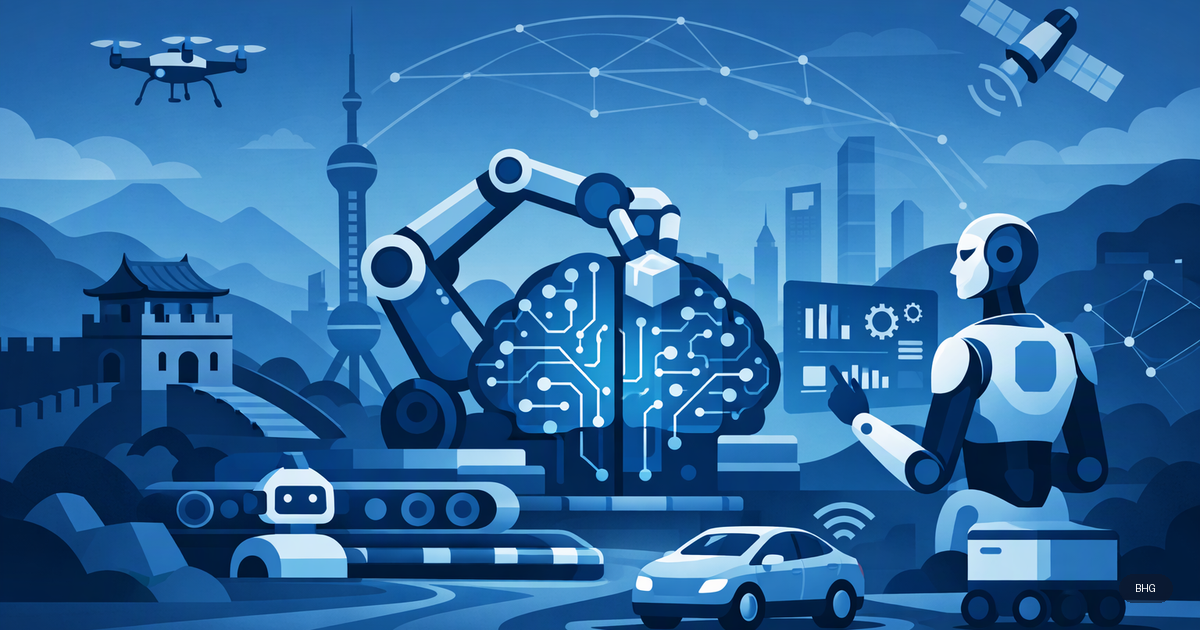
The week of November 9–15, 2026 shifted China’s AI contest from frontier-model spectacle toward industrial capacity. Beijing reportedly set a 200,000-robot production target, the National AI Industry Fund led an approximately $400 million Neolix financing, Shanghai expanded the status of scientific data, and cultural and workforce initiatives moved models into narrower operational settings.
Here is our professional analysis of this week’s most critical developments in Chinese AI. For CTOs and engineering leaders, the signal is clear: China is building the data, capital, compute, and specialist deployment layers around its models—not waiting for another headline general-purpose release.
Beijing: The 200,000-Robot Industrial Target
A 2026–2028 Embodied-AI Plan
AIGC News reported that Beijing released an embodied-AI robotics plan covering 2026–2028, with targets for annual capacity of 200,000 robots and 50,000 PFLOPS of dedicated computing capacity. These are industrial-system targets rather than model benchmark claims.
This is not merely a robotics roadmap—it is an attempt to align manufacturing throughput with dedicated AI infrastructure. If implemented, the plan would require enterprises selling compute, simulation, control software, sensors, and deployment services to treat embodied AI as a capacity-planning market.
Why this matters: Your China strategy should distinguish between model access and physical deployment capacity. A robotics program at this scale creates demand across integration, testing, fleet operations, safety controls, and data pipelines even without a new general-purpose model.
The reported targets should not yet be treated as delivered capacity. Procurement teams should track actual facilities, orders, and operational deployments against the 2026–2028 timeline rather than budgeting from the headline figures alone.
Neolix: The $400 Million State-Capital Signal
Big Fund Phase III Moves Into Autonomous Delivery
China Snapshot reported that the National AI Industry Fund, established through Big Fund Phase III, led an approximately $400 million financing round for autonomous-delivery company Neolix. The same report said the fund’s portfolio includes Moonshot AI, DeepSeek, MetaX, Galbot, and Chaitin.
The portfolio spans models, chips, robotics, security, and autonomous systems. That breadth matters more than any single investment.
For CTOs, the round indicates that Chinese state-linked AI capital is supporting a connected industrial stack rather than concentrating exclusively on foundation models. Autonomous delivery converts models into vehicles, routes, operating data, and recurring infrastructure requirements.
Why this matters: Enterprises evaluating Chinese AI suppliers should map ownership and financing relationships alongside product capabilities. Capital connections can influence ecosystem compatibility, procurement resilience, and the pace at which vendors expand capacity.
The approximately $400 million figure also establishes a meaningful benchmark for autonomous-delivery financing. It does not prove deployment economics, but it gives Neolix resources to pursue them.
Shanghai: Scientific Data Becomes AI Infrastructure
Rules Effective November 1
China Snapshot reported that Shanghai’s trial scientific-data measures took effect on November 1. The rules classify high-quality scientific datasets as research outputs and include unpublished and negative results.
Perhaps the most consequential element is the treatment of failed or inconclusive work. Negative results can help prevent models and researchers from repeatedly following unproductive paths, while unpublished material broadens the potential training base beyond formal papers.
This is not a routine records policy. It is a change in how research data can be valued, recognized, and potentially reused.
What this means for IT leaders: Scientific organizations operating in Shanghai should review dataset ownership, access controls, retention, provenance, and rights before expanding AI training workflows. Recognition as a research output raises the operational value of data, but it also increases the importance of governance.
Export Controls: 23 Technologies Remain Under Review
Announcement No. 48 Reaches Its Consultation Deadline
China Snapshot reported that MOFCOM and MOST Announcement No. 48 remained a proposal rather than a final regulation. The proposal would require pre-export registration for 23 AI-related technologies, include an open-source carve-out, and had a consultation period scheduled to end on November 15.
No final rule should be inferred from the consultation deadline. The distinction is operationally important.
For engineering leaders, the proposed registration requirement could add review steps to technology transfers if adopted, while the open-source carve-out may separate public releases from controlled commercial exports. Teams should avoid redesigning compliance processes around a proposal, but they should identify which repositories, models, and technical packages could require classification.
Why this matters: Create an inventory now, but wait for final text before enforcing new controls. This is compliance preparation—not a confirmed export ban.
Cultural AI: A Million-Scale Rights-Cleared Dataset
Shanhai Xuanji Targets History and Museums
China Snapshot reported that the CAS–Hunan initiative unveiled Shanhai Xuanji, described as China’s first large model focused on Chinese history and museums. The initiative also introduced a Huxiang-culture model trained on a rights-cleared, million-scale cultural dataset.
The rights status is central. Specialized cultural models depend not only on volume, but also on provenance and permission to use archival material.
This is not another general-purpose model race. It is domain AI built around controlled collections and institutional knowledge.
For museums, broadcasters, and cultural organizations, the practical lesson is to treat licensing metadata as part of model architecture. Your team needs traceability from generated output back to approved collections, especially where historical interpretation and institutional authority are involved.
China Snapshot’s coverage did not identify a nationally significant new general-purpose model release during the week. Sector-specific deployment carried the stronger signal.
Lenovo and Macau: Infrastructure Meets Skills
Wanquan Starts With a Zhangjiakou Facility
China Snapshot reported that Lenovo launched its Wanquan hybrid token-factory brand, combining AI infrastructure, intelligent-computing-center services, and agent software. Its first facility is planned for Zhangjiakou, Hebei.
The planned facility packages compute and software as one operating proposition. For buyers, that shifts evaluation from accelerator specifications toward utilization, agent integration, service levels, and workload portability.
30 Participants Enter a Four-Week Program
China Snapshot also reported that a Huawei-supported program will train 30 Macau youths over four weeks in large-model applications, DeepSeek, and AI coding.
The cohort is small, but its curriculum reflects the deployment stack: model use, a prominent Chinese AI platform, and software implementation. Enterprises should read this as workforce pipeline development rather than broad labor-market transformation.
Key Takeaways
- Track delivery against targets. Beijing’s 200,000-robot goal matters only as facilities, compute, and deployments materialize.
- Map the capital stack. Neolix’s approximately $400 million round links autonomous systems to a broader state-supported AI portfolio.
- Govern scientific data now. Shanghai’s rules elevate unpublished and negative results from neglected records to potentially valuable AI inputs.
- Prepare without overreacting. Announcement
No. 48remained a proposal as its November 15 consultation deadline arrived. - Budget for specialization. Cultural models, token factories, and focused training programs show China’s AI market moving deeper into operational sectors.
This weekly analysis is based on recent market developments, technical releases, and policy announcements shaping the trajectory of AI in China.